Security Solution for Construction Sites: How California Contractors Are Fighting Back Against a $1 Billion Theft Problem
Every contractor in California knows the feeling — you pull up to your job site Monday morning, and something is off. A generator is missing. A pile of copper wire is gone. A loader you need for the day’s pour has disappeared overnight. It’s not a nightmare. It’s the reality thousands of construction firms face every year, and it’s getting worse.
A reliable security solution is no longer optional for construction projects in California. It’s a business necessity — and for many contractors, it’s the difference between staying on schedule and eating a five- or six-figure loss that wrecks your margin before the foundation is even poured.
Construction site theft costs U.S. companies over $1 billion annually in lost equipment, materials, and tools. That number doesn’t account for project delays, insurance-claims headaches, subcontractor disputes, or the downstream cost of replacing specialized equipment with a 6–10-week lead time. When you factor all of that in, a single theft incident on a mid-size commercial project can easily escalate into a $250,000 problem.
And yet, most construction companies we speak with aren’t properly protected. In this post, we’re going to cover exactly why that gap exists, what thieves are actually targeting, what the most common myths about site protection really cost you, and what a modern security solution looks like for active construction sites in California.
Why Construction Sites Are Prime Targets
Before we talk about solutions, let’s understand the problem clearly.
Construction sites are attractive to thieves for a simple reason: they’re full of valuable, portable, and largely untraceable items sitting in an open or semi-open environment with minimal supervision during off-hours. Unlike a retail store with CCTV cameras, alarms, and staff, a construction site at 2 a.m. on a Tuesday is a different world. Perimeter fencing is often temporary. Lighting is inconsistent. Nobody’s watching.
Add to that the fact that most stolen tools and materials are resold within 24–48 hours — often through Facebook Marketplace, eBay, or Craigslist — and the economics for criminals are compelling. Low risk. Fast cash. And in most cases, law enforcement has bigger priorities than a stolen circular saw.
The result? Organized theft rings have made construction sites a primary target. These aren’t opportunistic teenagers grabbing a tool bag. Many theft operations are coordinated by teams who scout sites in advance, know exactly what they’re looking for, and can strip a location clean in under 30 minutes.
The 3 Most Stolen Items on California Construction Sites
Understanding what thieves want is the first step toward protecting it. Here’s a breakdown of the most commonly targeted items — and why each one creates a unique vulnerability.
1. Power Tools, Hand Tools, and Manual Equipment
This is the number one category — and it’s not close.
Power tools are the perfect targets for theft. They’re compact, easy to grab, universally in demand, and simple to resell. A quality Milwaukee or DeWalt kit can fetch $300–$500 on the secondary market within hours of being stolen. Multiply that across a job trailer full of equipment, and a single overnight visit from a determined thief could mean $15,000–$30,000 in losses.
Vacuums, chainsaws, sanders, drills, impact wrenches, and specialty trade tools are all on the list. Organized crime plays a major role in this market — theft rings specifically target job sites, hand off goods to fences, and flood online marketplaces with stolen inventory at steep discounts, undercutting legitimate sellers.
Here’s what makes this particularly frustrating: most power tools lack GPS or tracking technology. Once they’re gone, they’re gone. Store security cameras rarely deter experienced thieves. But live, monitored audio intervention does — and it works fast. A trained monitor speaking directly through an on-site speaker system will stop most intruders within seconds, not minutes. We’ve seen incidents where an unauthorized visitor cleared a site in under 15 seconds after being addressed by voice.
2. Copper and Raw Building Materials
If power tools are the most common theft target, copper is the most financially damaging one per pound.
Copper is king on the black market. It’s abundant on construction sites, easy to identify and grab, valuable by the foot, and nearly impossible to trace once it’s been stripped and sold to a scrap yard. The U.S. Department of Energy has documented over $1 billion in copper theft annually — and that’s just the direct loss figure, before you calculate project delays.
Beyond copper, metal roofing, lumber, cement, rebar, and other raw materials are consistently targeted. The financial pain isn’t just the cost of the materials themselves — it’s the impact on the schedule. Stolen lumber on a framing-phase project can delay you by a week or more while you wait for replacement materials. In a tight California construction market where every day of delay costs you in labor, penalties, and carrying costs, that’s a serious hit.
The COVID-era lumber shortage made this worse. At the peak of the shortage, lumber prices jumped nearly 200%, and theft followed the price spike. A single truckload of dimensional lumber became worth stealing in ways it simply wasn’t five years ago. Sophisticated theft crews took note — and they haven’t stopped.
Most raw materials sit in unsecured staging areas after shift ends, with no inventory tracking in place. There’s no alarm on a pile of copper wire. There’s no GPS in a stack of 2x6s. Which means the only real deterrent is active monitoring — and most sites don’t have it.
3. Heavy Equipment and Towable Assets
This is the highest-risk category in terms of dollar value per incident.
Loaders, tractors, excavators, backhoes — these are the machines that define what a construction crew can accomplish in a day. And they’re being stolen. Loaders account for an estimated 18–30% of heavy equipment thefts. Tractors represent another 10–20%. Excavators make up roughly 5%. The financial exposure per incident is staggering — we’re talking $50,000 to $500,000 or more per machine, depending on make, model, and configuration.
GPS tracking on heavy equipment helps — in theory. In practice, many theft operations involve professionals who know how to defeat or disable tracking devices before the machines leave the site. By the time law enforcement responds to a GPS alert, the equipment is on a flatbed heading to a chop shop or out of state. Recovery rates for stolen construction equipment hover around 20–25% nationally.
Towable assets are the second-most-stolen equipment category, accounting for roughly 20% of all equipment thefts, according to the National Insurance Crime Bureau (NICB) and the National Equipment Register (NER). Towable generators, welders, air compressors, light towers, and chippers are targeted specifically because they’re designed to be mobile. Hitched to a truck in under a minute. Gone in two. And nearly impossible to recover.
The 4 Myths That Leave Construction Sites Vulnerable
In our experience working with contractors across Southern California, the same misconceptions recur. Here’s what they are — and why they’re dangerous.
Myth 1: “It won’t happen to us.”
This is the most common and most costly belief. The reality is that every unsecured or under-secured construction site is a target. It’s not a question of if — it’s a question of when. Theft rings actively scout sites, catalog what’s there, and return when the timing is right. “It hasn’t happened yet” is not evidence of safety. It’s evidence that you haven’t been prioritized yet.
Myth 2: “We have GPS on the heavy equipment, so we’re covered.”
GPS tracking is one layer of protection — and it’s a useful one. But experienced thieves know how to defeat it. More importantly, GPS does nothing to protect your tools, copper, lumber, or towables. And even on equipment that does have GPS, the time between theft and law enforcement response is often long enough for the equipment to be loaded, transported, and partially stripped. You need a security solution that deters theft before it happens — not one that helps you file a report after.
Myth 3: “Insurance covers it, so it’s not a big deal.”
Filing a theft claim on a construction site isn’t as painless as it sounds. Deductibles add up. Premiums increase after claims. And there’s the problem of time — your insurer isn’t going to overnight a replacement $180,000 loader to your job site. The schedule impact of waiting for replacement equipment, materials, or tools is often worse than the direct financial loss. One major theft claim can put you in a difficult position with your carrier at renewal.
Myth 4: “A fence and some cameras are enough.”
Passive security — fencing, signage, and cameras that record but don’t respond — provides minimal deterrence to organized theft operations. Cameras are excellent for post-incident documentation. They are poor at stopping a determined crew that knows the cameras aren’t being monitored. The difference between a recording camera and a monitored camera with live intervention capability is enormous. One documents the crime. The other prevents it.
What a Modern Construction Site Security Solution Actually Looks Like
The security landscape for construction has changed dramatically over the last several years. Today’s purpose-built solutions are designed specifically for the realities of active construction — dynamic environments, evolving perimeters, remote locations, and the need for infrastructure that moves as the project moves.
Here’s what a capable modern security solution for construction sites delivers:
Portability That Matches the Job
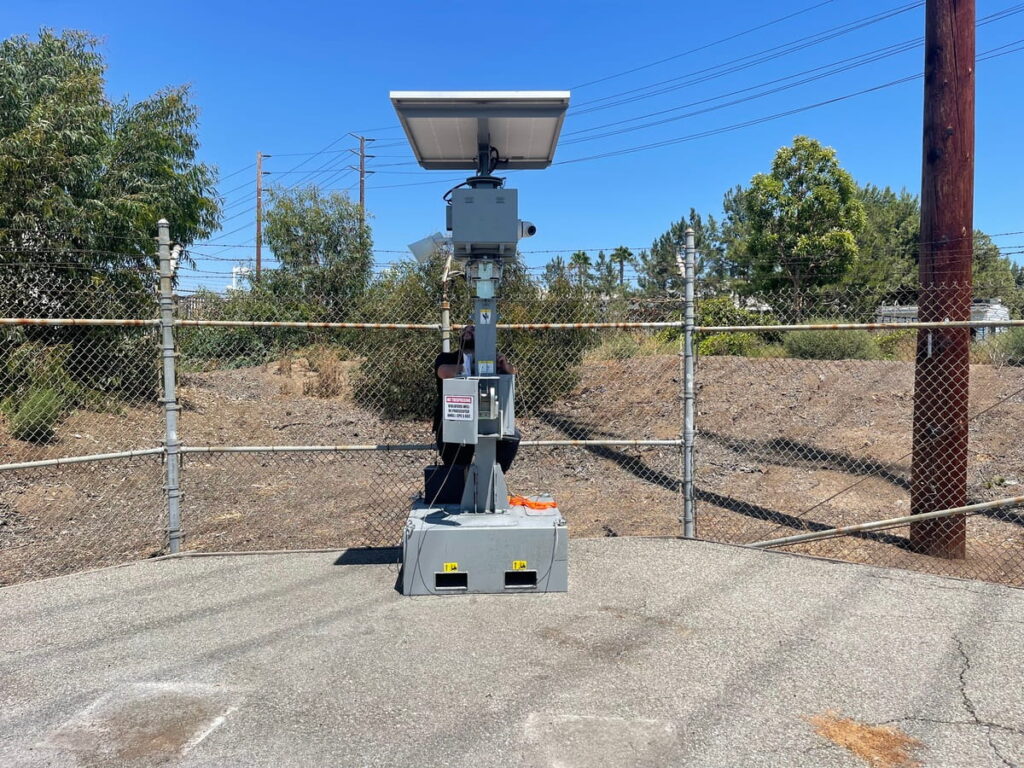
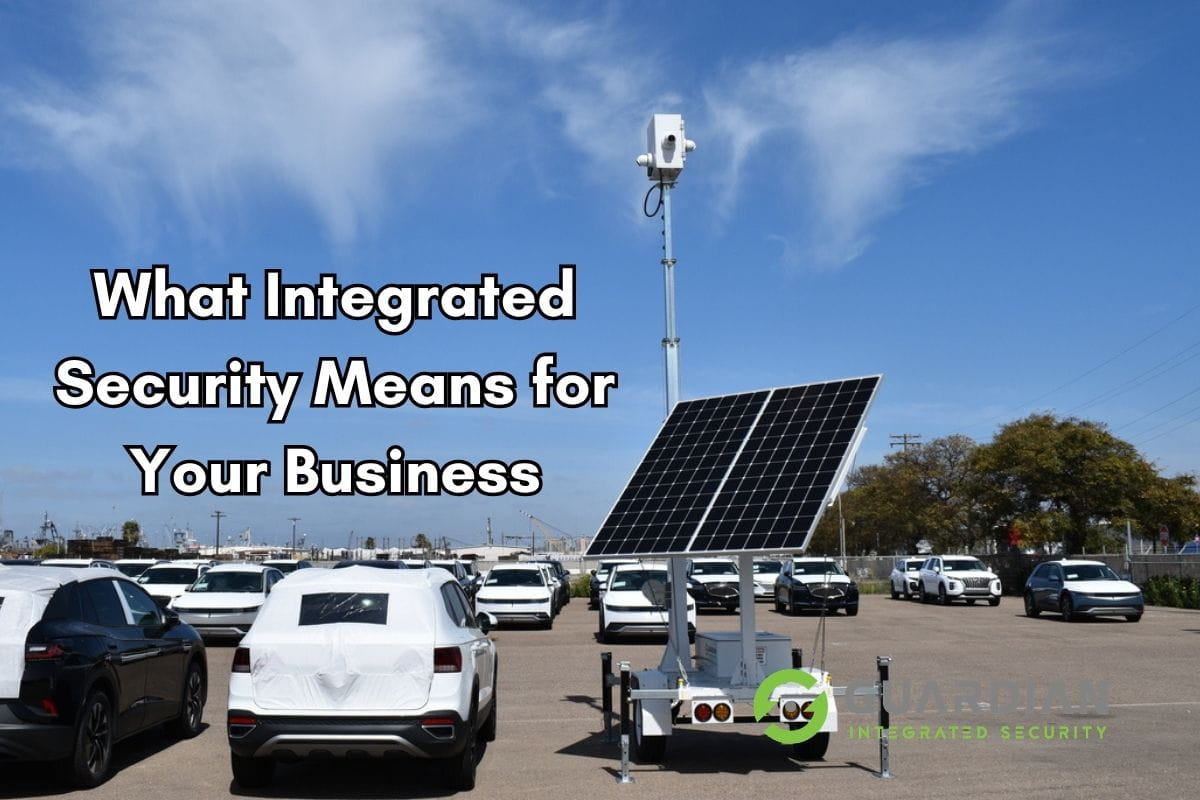
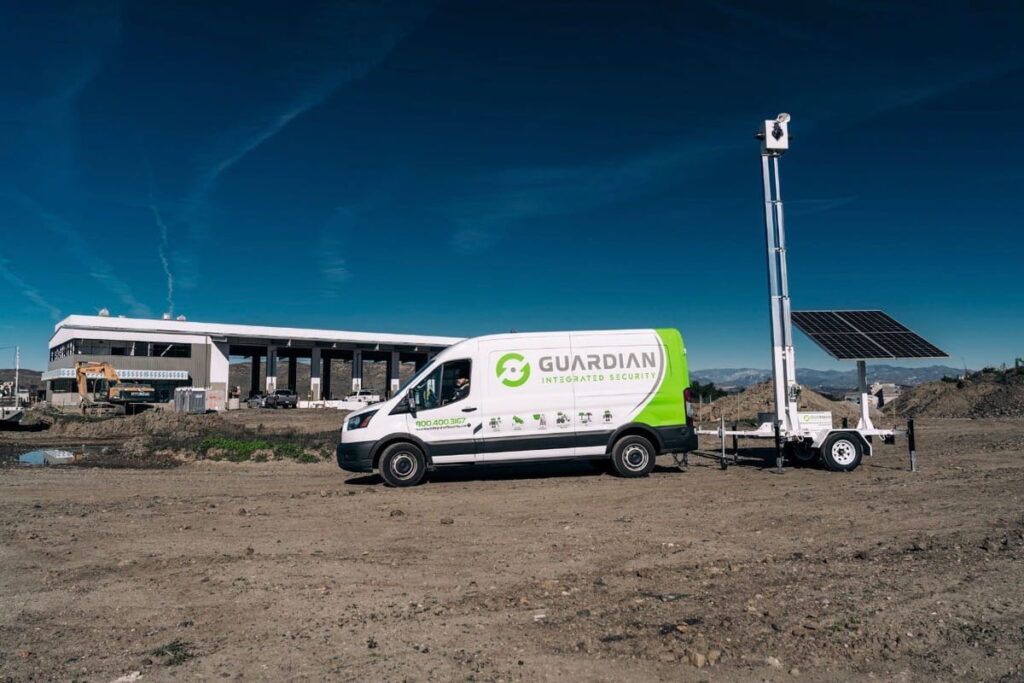
Construction sites aren’t static. Your perimeter changes as phases progress. Your staging areas move. What needed to be monitored in month one isn’t the same as what needs to be covered in month six. A security solution built for construction is portable and adjustable — it moves with you, not against you. No hardwired infrastructure. No lengthy installation. No cost to reconfigure.
Self-Contained Power and Connectivity
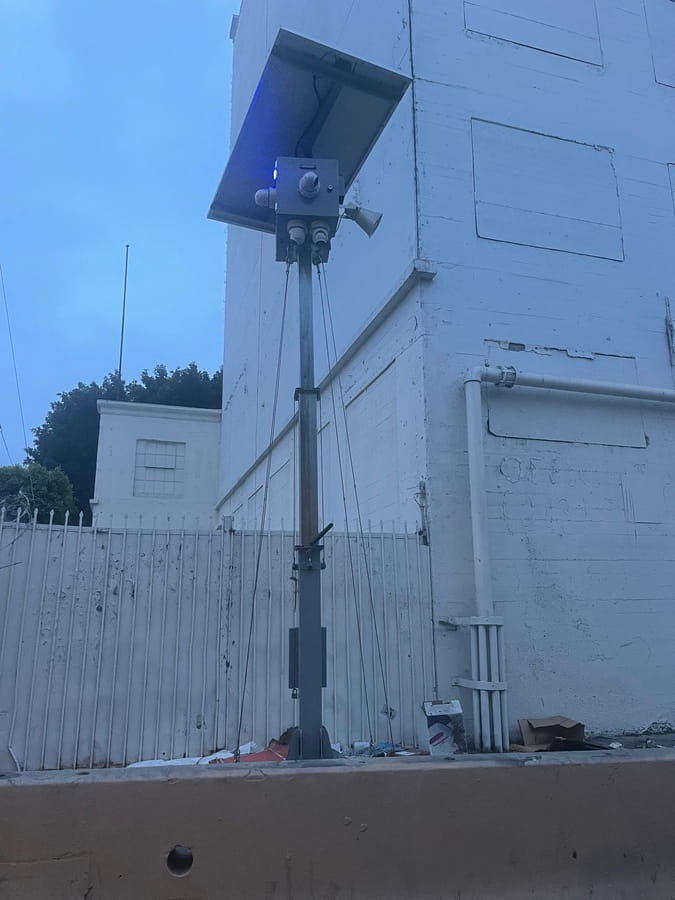
Construction sites frequently lack reliable power and internet infrastructure — especially in the early phases. A viable security solution for construction environments needs to run on its own power (solar, battery, or generator-backed) and its own cellular or wireless connectivity. No dependence on site utilities. Plug-and-play deployment that’s operational within hours of arrival.
24/7 Proactive Monitoring — Not Just Recording
The fundamental shift in modern construction site security is the move from passive recording to active, human-monitored surveillance. Trained security monitors watch live feeds in real time. When they detect unauthorized activity, they intervene immediately — through on-site audio speakers, by contacting law enforcement, or by dispatching a mobile response unit, depending on the situation and your escalation protocol.
This isn’t automated software flagging movement and emailing you a clip. It’s a trained professional making judgment calls in real time, with the authority and tools to respond. The difference in outcomes is dramatic. Intruders who encounter a voice telling them they’ve been identified and that police are en route respond very differently from intruders who see a camera blinking on a pole.
Insurance Compliance and Documentation
Many commercial general liability and builders’ risk policies include security requirements — particularly for larger projects or sites with high-value equipment. A professional security solution helps you meet those mandates, document compliance, and provides the incident records your insurer needs if a claim does occur. Beyond that, thorough monitoring records can help you fight fraudulent claims from individuals who allege injuries on your site.
Safety Protocol Enforcement
Security cameras and monitoring aren’t just about theft. They’re a powerful tool for enforcing your own safety standards. OSHA compliance, PPE enforcement, restricted area access, fall protection — a monitored camera system lets your supervisors and safety officers see what’s happening on-site in real time, identify violations before they become incidents, and document your safety culture for project owners and insurers.
Dramatic Cost Advantage vs. On-Site Guards
A traditional security guard approach for a construction site — particularly one requiring after-hours coverage — can cost $15,000–$25,000 per month, depending on location, shift length, and staffing requirements. A modern technology-based security solution with live monitoring typically costs 70% less than the equivalent guard presence. That’s not a rounding error. On a 12-month project, the difference can easily exceed $100,000 in direct security labor savings — money that goes straight back to your job cost budget.
Real-World Results: What Guardian Clients Are Saying
We work with contractors and property managers throughout California, and the feedback from clients who’ve transitioned to a professional, monitored security solution is consistent.
“Guardian really helps keep us aware of what’s going on with our job sites. The protection service has done very well for us. And they are responsive if we ask them to send us pictures.” — Tommy Lam, Manager, Figure 8 Group, Inc.
That kind of visibility — knowing what’s happening on your site at any given moment, being able to request documentation, having a responsive team watching your assets — is exactly what modern construction security delivers.
How to Evaluate a Security Solution for Your Construction Site
If you’re in the process of evaluating options for your project, here are the questions that matter:
Does the system work without site utilities? If the answer is no, you’re dependent on infrastructure that may be unreliable or unavailable in the early project phases.
Is monitoring live or automated? Automated AI flagging has a role in reducing false alerts, but you want human eyes on your site when something real is happening. Ask who is watching, when, and what their escalation protocol is.
How quickly can the system be deployed and relocated? If your site configuration changes every 60–90 days, you need a solution that moves with you without a lengthy setup process or additional cost.
What’s the response chain when something happens? From detection to intervention to law enforcement notification to guard dispatch — you want a clear, documented protocol before you sign a contract.
Can the system support safety compliance monitoring? If you can use your security investment to also manage OSHA compliance and reduce your incident exposure, that’s a meaningful multiplier on ROI.
What are the insurance implications? Ask your broker whether a professionally monitored security solution affects your builders’ risk or CGL premiums. In many cases, it does — favorably.
The Bottom Line: Proactive Protection Pays
A $1 billion annual theft problem doesn’t happen because contractors are careless. It happens because the economics of construction — tight margins, complex logistics, high-value materials, and constantly moving equipment — create inherent vulnerabilities that passive security measures can’t adequately address.
The security solution that closes that gap is one that’s active, monitored, responsive, and purpose-built for construction environments. It’s portable. It’s self-sufficient. It intervenes in real time, not after the fact. And it costs a fraction of what a guard force would run you.
California contractors face enough variables outside their control — labor markets, material costs, permitting delays, and weather. Your security posture is one variable you can actually control. And controlling it means protecting your schedule, equipment, materials, subcontractors, and bottom line.
Guardian Integrated Security offers free, on-site threat assessments for construction projects throughout Southern California. Our specialists will walk your site, identify your vulnerabilities, and recommend a solution that fits your project scope, timeline, and budget — with no obligation.