Construction Site Security Tips: The Complete Guide to Cameras, Monitoring, and Proven Solutions
Construction sites are unlike almost any other commercial environment. They’re sprawling, constantly changing, and filled with expensive equipment, raw materials, and a rotating cast of workers, subcontractors, and visitors. That combination makes them among the most challenging environments to secure — and among the most costly to leave unprotected. Equipment theft, vandalism, unauthorized access, and liability exposure from on-site injuries can derail a project’s budget and timeline before it ever gets off the ground.
This guide covers everything you need to know about construction site security — from identifying vulnerabilities and running a security audit, to selecting the right surveillance cameras, deploying access control, and building a layered protection strategy that actually holds up in the field. Whether you’re managing a single-site residential development or a large commercial build, these principles apply.
The Importance of Construction Site Monitoring
The financial stakes on a construction site are enormous. At any given time, you may have hundreds of thousands of dollars’ worth of heavy machinery, copper wire, lumber, HVAC components, and tools sitting on an open lot. The National Equipment Register estimates that construction equipment theft costs the U.S. industry between $300 million and $1 billion annually. Those losses rarely get fully recovered — insurance payouts come with deductibles, project delays, and the administrative burden of filing claims and sourcing replacement materials.
But the risks extend beyond theft. Vandalism can destroy completed work. Unauthorized access by trespassers creates serious liability exposure, particularly if someone gets injured on the site after hours. Subcontractors or workers operating without proper oversight can create safety hazards that lead to OSHA violations, fines, or worse. And without a documented surveillance record, proving what happened in any of these situations becomes difficult or impossible.
Effective construction site security monitoring addresses all of these concerns simultaneously. A well-designed system deters criminal activity before it happens, captures footage when incidents occur, and gives project managers real-time visibility into what’s happening on site — even when they’re not physically present. Construction site security isn’t just a line item in the project budget. It’s a risk management strategy that protects the entire investment.
Recognizing Vulnerabilities
Before you can build an effective security plan, you need to understand exactly where your site is exposed. Every construction project is different, but most share a common set of vulnerabilities that bad actors can exploit.
Perimeter gaps are one of the most common entry points for theft and vandalism. Temporary chain-link fencing gets cut, bent back, or simply walked around at unmanned corners. On large sites, it’s easy for someone to slip in and out without being seen, particularly at night or during shift transitions when attention is divided.
Poor lighting dramatically increases risk after hours. Most construction equipment theft happens between midnight and 5 a.m., when sites are dark, and patrols are infrequent. Without adequate lighting, cameras become ineffective, guards can’t see what’s happening at the perimeter, and criminals have cover to operate undisturbed.
Unsecured material staging areas are essentially open invitations. Copper wire, lumber, and HVAC components are regularly targeted because they’re easy to carry, hard to trace, and simple to resell. When these materials are left in open, unmonitored areas, the risk multiplies significantly.
Inconsistent access control is another major vulnerability. On active job sites, the flow of people — workers, inspectors, delivery drivers, subcontractors — can make it feel impossible to track who’s coming and going. But that chaos is exactly what opportunistic thieves count on. A worker who walks onto a site without being properly vetted, or a vendor who has no legitimate reason to be there after 5 p.m., represents a serious security gap.
Equipment left running or unlocked is both an invitation and a liability. Heavy machinery that isn’t immobilized at the end of the day can be operated or moved by anyone with basic skills.
Taking the time to walk your site with security vulnerabilities in mind — ideally before work begins — gives you the information you need to build a plan that addresses your specific risks rather than a generic checklist.
Security Audit Checklist
A formal security audit is the foundation of any serious construction site security program. Rather than reacting to incidents after they happen, an audit lets you identify and address problems proactively. Here’s what a thorough audit should cover:
Access Points: How many entry and exit points does the site have? Are all of them gated and lockable? Is there a primary entrance where access is actively controlled during working hours? Are secondary and emergency access points secured when not in active use?
Lighting: Walk the perimeter and interior of the site after dark. Identify any areas where lighting is insufficient. Pay particular attention to material storage areas, equipment yards, and access points. Motion-activated lighting can extend coverage without requiring permanent electrical infrastructure.
Existing Security Infrastructure: If any cameras, alarms, or monitoring systems are already in place, evaluate their coverage, condition, and effectiveness. Are there blind spots? Are cameras positioned to capture clear, identifiable footage of faces and license plates, or are they just set to wide-angle views that won’t hold up as evidence?
Material and Equipment Inventory: Are high-value materials secured in locked containers or staged in areas with dedicated surveillance? Are serial numbers and identifying information documented for major equipment? Is GPS tracking installed on heavy machinery?
Personnel Protocols: Are workers and subcontractors required to check in through a defined access point? Is there a process for verifying that vendors and delivery drivers are authorized to be on site? What happens when someone is found in an area they shouldn’t be?
Emergency Response: Does your security team have clear protocols for responding to after-hours alerts? Is there a communication chain that quickly notifies the right people when an incident occurs?
The output of a thorough security audit should be a written security plan that addresses every identified gap. That plan becomes the blueprint for everything that follows.
Construction Site Security Cameras: Eyes That Never Blink
Security cameras are the backbone of any modern construction site security program. Unlike human guards, cameras don’t get tired, don’t take breaks, and don’t have blind spots in their attention. A well-placed camera network provides 24/7 coverage of your entire site — and the footage it captures can be the difference between recovering stolen equipment and absorbing the loss entirely.
High-Tech Surveillance
The capabilities of modern construction security cameras have advanced dramatically in recent years. Today’s professional-grade systems offer features that were either prohibitively expensive or simply unavailable a decade ago.
High-definition video is now the standard, not a premium upgrade. Modern cameras capture 4K or 1080p footage that’s detailed enough to read license plates, identify faces, and document serial numbers on equipment. That level of detail matters when you’re working with law enforcement or filing an insurance claim.
Night vision and low-light performance have improved to the point where after-hours footage is nearly as useful as daytime footage. Infrared illumination allows cameras to capture clear images in complete darkness, while some systems use thermal imaging to detect body heat even when visibility is zero.
Motion-triggered recording and alerts allow your security team to be notified immediately when activity is detected in a monitored zone. Rather than reviewing hours of uneventful footage, operators can focus their attention on flagged events in real time.
Remote access and cloud storage mean project managers and security personnel can monitor live feeds and review recorded footage from anywhere — a laptop in a site trailer, a phone on a job site across town, or a monitoring center hundreds of miles away. Cloud-based storage eliminates the risk of on-site recording equipment being stolen or damaged, as well as other risks.
AI-powered analytics are becoming increasingly common in high-end systems. These features can automatically detect when a vehicle enters a restricted zone after hours, when someone is lingering near a material storage area, or when an object that was previously present has been removed. Rather than relying on a human operator to catch everything, the system flags what matters.
Strategic Camera Placement
Having the right cameras is only half the equation. Where you place them determines how much of your site you can actually see — and how useful the footage will be if something goes wrong.
Entry and exit points are the highest priority. Every access point should have at least one camera positioned to capture clear images of people and vehicles entering and leaving the site. License plate capture is particularly valuable, since it gives law enforcement a concrete lead when equipment is stolen and transported off-site.
Material storage areas should be treated as high-value targets and covered accordingly. Multiple camera angles reduce blind spots and make it harder for anyone in the area to avoid being recorded.
Equipment yards housing heavy machinery, generators, and high-value tools deserve dedicated coverage. If equipment is staged in an area that’s difficult to reach with permanent camera infrastructure, portable or battery-powered options can fill the gap.
Perimeter fencing coverage allows your team to spot a breach attempt before it becomes a full intrusion. Cameras positioned along the fence line can detect cutting, climbing, or other tampering activity in real time.
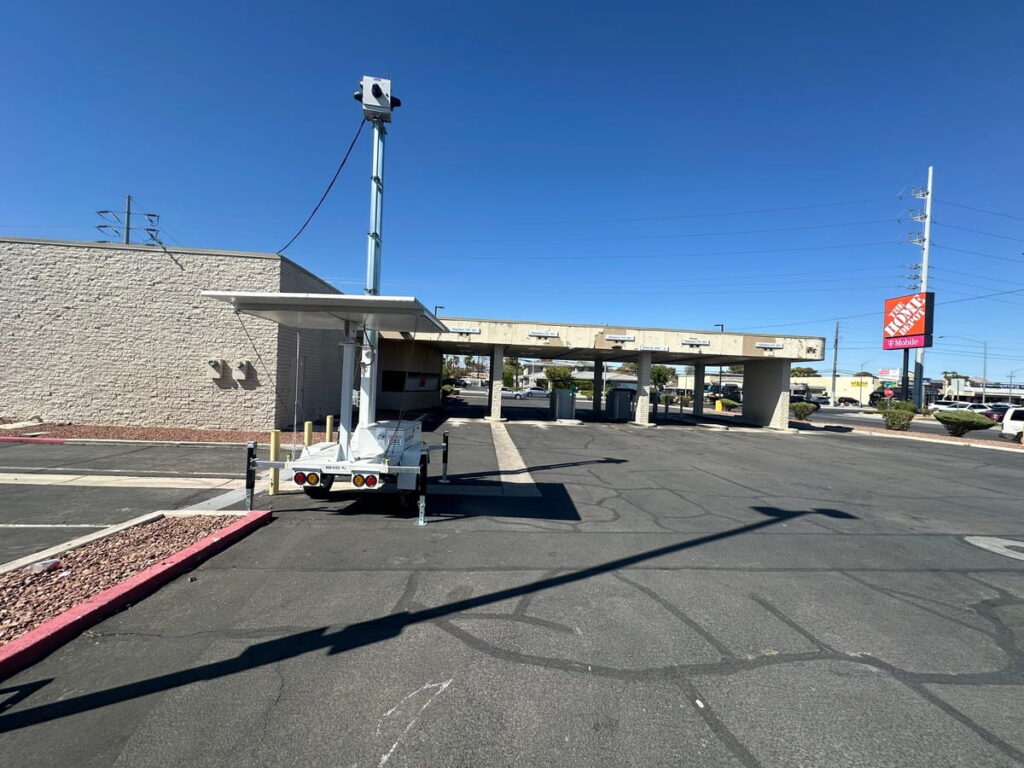
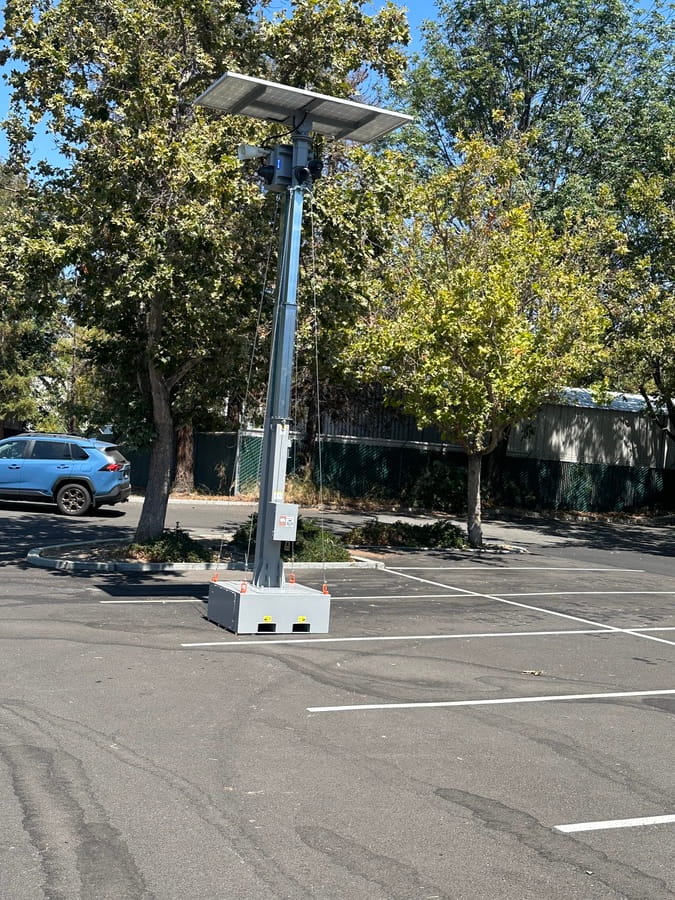
For construction sites that lack reliable power or internet infrastructure — particularly in early build phases before electrical systems are in place — mobile surveillance trailers offer a fully self-contained solution. These trailer-mounted units include integrated cameras, solar or battery power, cellular data connectivity, and sometimes floodlighting and speaker systems, all deployable in hours without any site infrastructure in place. They can be repositioned as the project evolves and the security needs of different zones shift.
Site Security Solutions: Mitigating Risks Effectively
Cameras provide visibility, but a complete construction site security program requires additional layers of protection. The most effective strategies combine technology, physical controls, and trained personnel into a system where each element reinforces the others.
Access Control Systems
Controlling who can access your site — and when — is one of the most powerful tools in your security arsenal. Unrestricted access is an open invitation to theft and unauthorized activity. A structured access control system eliminates that vulnerability.
Keyed or coded gate locks are the simplest form of access control, but they have limitations. Keys get duplicated, codes get shared, and neither records who entered or when. For most serious security programs, they’re a starting point rather than an endpoint.
Key card and fob systems add a layer of accountability. Each authorized worker or subcontractor is issued a unique credential, and every access event is logged. If a card is lost or a worker’s authorization needs to be revoked, the system can be updated immediately without changing physical locks.
Biometric systems — fingerprint scanners, facial recognition, iris scanning — provide the highest level of identity verification and eliminate the possibility of credential sharing. A worker can hand off their key card; they can’t hand off their fingerprint. Biometric access control is particularly valuable at sites where high-value materials or sensitive areas require restricted access.
Vehicle access control using boom barriers, tire-spike deterrents, or manned checkpoints ensures that unauthorized vehicles can’t simply drive onto the site. When paired with license plate recognition cameras, vehicle access logs provide a detailed record of every truck, van, or car that enters the property.
Whatever system you choose, the goal is the same: ensure that only authorized people can access the site, and create a documented record of every access event.
Security Personnel and Training
Technology can monitor your site around the clock, but there are situations where a trained human response is irreplaceable. A camera can document an incident; a security officer can intervene before it escalates.
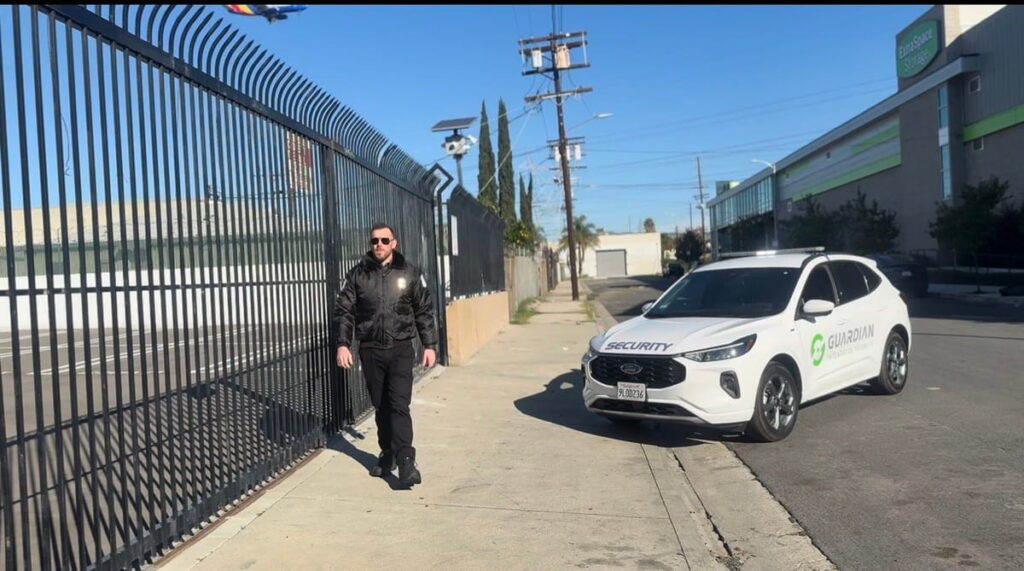
Deploying professional security personnel provides active deterrence that cameras alone can’t. A visible guard presence signals to potential criminals that the site is monitored and that intervention is possible. That deterrence effect extends well beyond the immediate area where a guard is stationed.
However, maintaining full-time, on-site guards around the clock is expensive — often prohibitively so for smaller projects. That’s where live video monitoring has become a powerful alternative. In a virtual guarding model, trained remote operators monitor live camera feeds from a central monitoring center, providing real-time oversight without the cost of full physical staffing. When an alert is triggered or suspicious activity is detected, operators can issue a live audio warning through on-site speakers, contact local law enforcement, or immediately alert on-site personnel.
Many construction projects benefit from a hybrid approach that combines virtual guarding for continuous overnight monitoring with physical guards during peak-risk periods — shift transitions, material deliveries, or phases of the project when particularly high-value components are on site.
Regardless of whether security personnel are physical or virtual, training is non-negotiable. Guards need to understand the site layout, know which zones require heightened attention, recognize the difference between authorized and unauthorized activity, and have clear protocols for emergency response and escalation. A guard who doesn’t know what to do in a crisis is only marginally better than no guard at all.
Nighttime Security on Construction Sites
After-hours protection deserves its own focus, because the risk profile changes significantly once the work day ends. Criminal activity at construction sites is heavily concentrated in the overnight hours, when normal deterrents are reduced and response times are longer.
Lighting is the single most cost-effective nighttime security measure available. Well-lit sites are harder to work in undetected, and adequate lighting dramatically improves the usefulness of camera footage. Motion-activated floodlights are particularly effective because they’re startling — someone moving through a dark site and suddenly being bathed in bright light is likely to leave immediately.
Night-vision cameras ensure that your surveillance network doesn’t go blind when the sun goes down. Modern infrared cameras provide clear, detailed footage in complete darkness. Thermal cameras add another layer of capability, detecting body heat through smoke, fog, and other conditions that defeat standard night vision.
Scheduled security patrols — either physical or virtual — create unpredictability that works in your favor. A criminal who knows that a guard walks the perimeter at 2 a.m. sharp will simply avoid that time slot. Irregular, randomized patrol schedules are much harder to plan around.
GPS tracking on equipment is a passive but powerful tool for nighttime protection. If machinery is moved off site without authorization, GPS tracking gives law enforcement a real-time location and dramatically increases recovery rates. The visibility of GPS tracking decals on equipment also has a deterrence effect.
Protecting Expensive Construction Equipment
Heavy machinery represents some of the largest single investments on any construction site, and it’s among the most frequently targeted by organized theft rings that know exactly how to move and resell it.
Beyond the camera placement and GPS tracking strategies already discussed, a few additional measures are worth considering. Equipment immobilizers — devices that prevent a machine from starting without an authorized code or credential — make theft physically harder even if someone gets to the equipment. Secure equipment parks with dedicated fencing, lighting, and surveillance keep high-value machines concentrated in an area where monitoring is easiest. Inventory documentation, including photos, serial numbers, and machine hours, ensures that if equipment is stolen, law enforcement has what they need to identify and recover it.
Conclusion
Construction site security is not a passive checkbox — it’s an active, evolving program that has to keep pace with the project itself. The vulnerabilities that matter most in the excavation phase are different from those that matter during framing or finish work, and your security plan should adapt accordingly.
The most effective programs layer multiple tools and strategies together: comprehensive camera coverage, structured access control, adequate lighting, GPS-equipped equipment, trained personnel, and real-time monitoring. No single measure is sufficient on its own, but combined thoughtfully, they create a security environment where theft, vandalism, and unauthorized access are genuinely difficult to carry out undetected.
Guardian Integrated Security specializes in building exactly these kinds of layered, site-specific security programs for construction clients across California. From mobile surveillance trailer deployment to virtual guarding services that provide 24/7 live monitoring at a fraction of the cost of full physical staffing, Guardian has the technology and expertise to protect your project from groundbreaking to final inspection. Contact us for a free site threat assessment and find out what a purpose-built construction security program looks like for your specific site.