
Serving San Diego County
Self Storage Security in San Diego
A gate code doesn’t ask whose hand typed it — San Diego’s own police data calls that gap “legal access,” the same entry point behind the 370 thefts-from-buildings the city logs every year, from a San Ysidro border lot to a Kearny Mesa drive-up row. Guardian’s agents watch San Diego self-storage facilities live, 24/7, warn intruders off the aisle before a unit door opens, and alert SDPD with what they actually saw.
NDAA-Compliant Equipment
BBB A+ Rated
CA PPO #121089 · ACO #7501
2,700+ California Businesses Protected
20+ Years in Business
The Challenge
California Gives a San Diego Storage Operator a Lien, Not a Lock
Self storage security in San Diego is an occupancy problem before it is a building problem: one break-in costs the operator the tenant who leaves, the claim nobody budgeted for, and the review every future prospect reads.
The law does not fill that gap. The California Self-Service Storage Facility Act defines a facility as property rented to occupants who “are to have access to the space,” gives the owner a lien on everything stored, and sets out how that lien is enforced: once rent is 14 consecutive days late the owner may send a termination notice, and only after the date that notice specifies — which must be at least 14 days after it is mailed — does the lien attach and the owner may deny access, enter the space and remove the contents. It says nothing about cameras, lighting, gates or guards; what protects a paying tenant’s unit is whatever the operator puts on the property.
San Diego’s own police data has no field that isolates a storage facility from any other building — but it does isolate the loss that defines an unwatched one. The FBI’s own crime-reporting standard has a category for exactly this: “Theft From Building,” a theft where the offender needs no forced lock, just legal access. SDPD logged 370 of them citywide in 2025, and 128 — better than one in three — were serious enough to charge as grand theft. A gate code is legal access. Live video monitoring puts a trained agent on the gate, the aisles and the corridors while someone is using that access wrong — a spoken warning before anything leaves the property, a verified description to law enforcement if the person keeps going. Drive-up rows and vehicle lots without fixed power get the same coverage from rapid-deploy surveillance trailers.
“If the notice has been sent as required by Section 21703 and the total sum due has not been paid by the termination date specified in the preliminary lien notice, the lien imposed by this chapter attaches as of that
date and the owner may do all of the following: (1) Deny an occupant access to the space. (2) Enter the
space. (3) Remove any property found therein to a place of safekeeping.”
— California Business and Professions Code § 21705(a), Self-Service Storage Facility Act
Access Is Denied by Notice, Not on Day 14
Under B&P Code §§ 21703–21705 access ends only after a mailed termination notice runs at least 14 more days unpaid — the Act's only access rule.
No Security Standard in the Act
Sections 21700–21716 cover the lien, the notices and the sale. None requires cameras, lighting, alarms or guards.
370 "Theft From Building" Offenses in San Diego
SDPD recorded 370 offenses in this category citywide in 2025 — the FBI's own term for a theft that needed no forced entry, just access.
Better Than One in Three Was Grand Theft
128 of the 370 — 34.6% — were charged as grand theft under state law's $950 line; the rest, petty theft.
More in San Diego
All Guardian Services in San Diego

24/7 live agent monitoring for San Diego self-storage gates, drive aisles and unit corridors.

NDAA-compliant camera systems for gates, elevator lobbies, hallways and drive-up rows.

Solar-powered, rapid-deploy units for San Diego drive-up rows, RV lots and expansion phases.

Licensed guards for San Diego storage offices, auction days and staffed-lobby hours.

Marked vehicle patrol across your San Diego storage lots, perimeters and vehicle rows.

What We Watch
Every Gate, Aisle and Corridor: What Guardian Watches at a San Diego Storage Facility
Guardian’s storage facility monitoring puts trained human agents on your property’s camera feeds in real time — gates, drive aisles, hallways, elevator lobbies, the perimeter fence and the office door — watching for break-ins, tailgating and after-hours trespass instead of leaving footage for review after a tenant reports a cut lock.
AI flags activity on camera in under a second. A live agent verifies what triggered it and, if it is a real intrusion, speaks to the person through on-site speakers before a unit door comes open, then alerts and coordinates with law enforcement and sends you a documented incident report.
The economics are why most operators switch: on-site guards run $25–30 per hour, while live video monitoring runs under $3 per hour — roughly 70% less for continuous coverage of every aisle rather than one office window.

Our Operations Center
After the Gate Locks: How Our California Operations Center Covers San Diego Storage Facilities Overnight
A lot of San Diego self-storage facilities keep access hours that outlast the staff — the office in front closes early, but the gate on a Kearny Mesa drive-up row or an Otay Mesa vehicle lot keeps taking codes for hours after. From that point until the property reopens, nobody employed there is watching what happens on it. Guardian’s California operations center is who is: a trained agent on the live feed for every San Diego facility it protects, watching the aisle and corridor as it happens instead of pulling footage after a tenant calls. AI flags the activity in under a second; the agent confirms it on camera and speaks to the person over the site speakers before a unit door opens.
San Diego’s own alarm code sets a different bar than a live camera, and it is worth an operator knowing the gap. Under San Diego Municipal Code § 33.3716, before an alarm company can even ask San Diego police to respond to a signal, it must complete “enhanced call verification” — two separate contact attempts to the alarm user, in person, by phone or by another electronic means — and that requirement applies to the very first alarm, not just repeat false ones. Nowhere in the ordinance’s own definitions does a video or camera view count as verification; San Diego’s code, unlike some others, never says a look at the feed is enough. A facility running an alarm system also needs a police-issued permit under § 33.3707(a), and once an authorized responder is asked to attend, San Diego’s code gives them 30 minutes to reach the site under § 33.3709. Our San Diego team’s agent is already watching the camera live when AI flags something — no two-call clock has to run first — and alerts SDPD with a description and the exact location while the person is still on the property, sending Guardian’s own licensed patrol when an on-site presence is needed.
Our Process
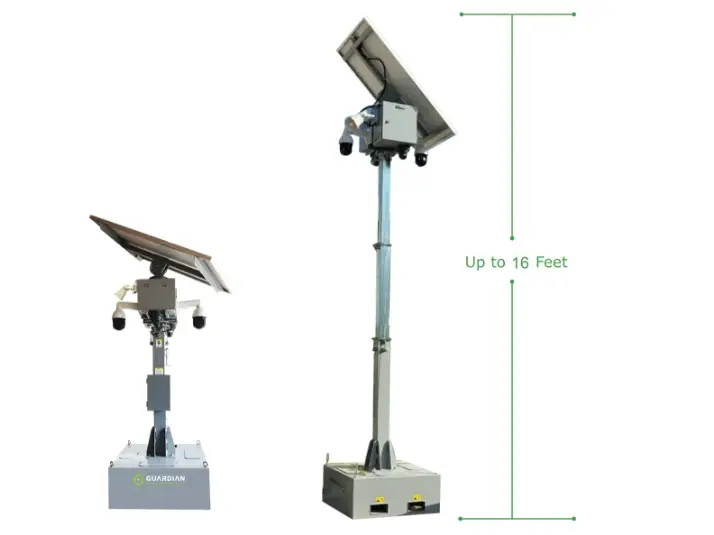
How a Guardian Trailer Deployment Works, Step by Step
a simple, proven process that keeps your business protected 24/7,
Assess
We walk the property with you — perimeter, lighting, blind spots, and the access points that matter after hours.
Install
NDAA-compliant cameras and on-site speakers, installed by Guardian’s licensed California technicians. Fast deployment for active job sites.
Verify
Our agents watch the feeds live. AI flags activity in under a second; a human confirms what it is.
Respond
Two-way audio warning on the spot, law enforcement alerted with verified detail, and a written incident report to you.
Property Types
Where San Diego Stores Its Belongings: Border Lots, Freeway Corridors and Central Industrial Rows
San Diego self-storage does not come in one shape. Along the U.S.–Mexico border, San Ysidro and Otay Mesa carry vehicle, RV and cross-border storage lots pressed against the Otay Mesa Port of Entry — SDPD’s own 2025 data puts San Ysidro at the top of the city’s neighborhoods for “Theft From Building” offenses, 25 of them. Mission Valley’s stretch along I-8 — Mission Valley East and West together logged 27 more — is San Diego’s classic multi-story, climate-controlled storage corridor. Kearny Mesa and Miramar, the city’s central industrial belt, add drive-up rows behind coded gates, while University City and the Midway District carry facilities serving the UTC office corridor and the airport district — both also among the ten San Diego neighborhoods logging the most of the same offense category in 2025.
Guardian covers all of it — fixed cameras and speakers for a multi-story building with defined entries and corridors, solar-powered surveillance trailers for a drive-up row, a vehicle lot or an expansion phase that needs coverage this week — across San Diego County, including Chula Vista, National City and El Cajon.
Drive-Up Rows & Vehicle Lots
Why a Gate Code Is Not a Security Plan for a San Diego Storage Facility
A coded gate can only tell you which code was used, not who used it. San Diego’s own crime data shows how often that gap gets exploited: the FBI classifies entry by an ex-tenant, a subletter, or anyone still holding a working code as “legal access” rather than burglary, and it’s the same theft-from-building category the city logs 370 times a year. Past the gate, a drive-up row in Kearny Mesa or Miramar is open ground, dim between the wall-pack lights. A multi-story Mission Valley building trades that for hallways with no gate once someone is inside. A border-area vehicle or RV lot in San Ysidro or Otay Mesa has neither walls nor aisles, just open parking. Guardian designs for the property it is actually watching: cameras and speakers on the buildings, and where a row or lot runs too long for them, a solar-powered trailer at its end looking down the aisle.
San Diego’s own case data shows what happens when nobody is watching: SDPD’s case-approval date lands a median 3.5 days after the offense, and in 140 of last year’s 370 thefts-from-buildings that gap ran a week or longer. Guardian closes that gap the moment it opens — the agent spots the person at the gate or between doors, speaks to them before a lock is touched, and if they stay, hands SDPD a live description and the exact location while they are still on the property. The written incident report that follows gives the operator something concrete for the tenant and the insurer’s adjuster, not a guess assembled days later.
San Diego Clients
Trusted by California Businesses for Two Decades
“Our liquor store had few break ins recently but since they deployed their security unit we feel very secure and have peace of mind now! They constantly dispatch warnings to suspicious trespassers!”
— Nabil Tadlaoui, Google Review
Nabil Tadlaoui Google Review
San Diego Data
San Diego Logged 370 "Theft From Building" Offenses in 2025 — a Category That Needs No Broken Lock
San Diego’s own police data has no field that isolates a storage facility from any other building, so this page reads the citywide category the FBI defines for the loss a coded gate makes possible: “Theft From Building” — legal access, not a forced lock. SDPD’s 2025 offense data records 370 of them citywide. 128 — 34.6% — were serious enough to charge as grand theft under state law’s $950 line; the remaining 242 were petty theft. By division, Western logged the most (66), followed by Central (55), Northern (51), Eastern (48) and Mid-City (46).
SDPD’s own case-report data shows these losses do not move quickly through the system: the department’s own case-approval date lands a median of 3.5 days after the offense date, and 140 — 37.8% — were not approved in SDPD’s own records until a week or more after the offense date. That is the department’s own case-processing timeline, not a measure of when a tenant first noticed, but it points the same direction: a loss that needed no forced entry is also one nobody was watching happen.
Source: San Diego Police Department, NIBRS Offenses Dataset, City of San Diego Open Data (seshat.datasd.org, 2025 export). Calendar-year 2025 offenses coded “Theft From Building” (FBI NIBRS code 23D); the case-report interval is the difference between the offense date and SDPD’s own case-report approval date, as defined by the dataset’s own data dictionary — not a public report-received date. Queried 3 September 2026. The dataset carries no premise-type field and no clearance/status field.
See the citywide data: San Diego Commercial Burglary Statistics
FAQ
Questions San Diego Storage Operators Ask Guardian
Does California's Self-Service Storage Facility Act require a San Diego storage operator to provide security?
No. The Act — Business and Professions Code §§ 21700–21716 — governs the rental agreement, the lien and the lien sale: after 14 consecutive days of unpaid rent the owner may send a termination notice setting a date at least 14 days out, and only if the sum is still unpaid on that date may the owner deny access, enter the space and remove the contents. No section requires cameras, lighting, alarms or guards. What protects a paying tenant’s unit in San Diego is whatever the operator puts on the property — SDPD’s own 2025 data recorded 370 “Theft From Building” offenses citywide, defined by legal access, not a broken lock.
How much of San Diego's "Theft From Building" losses are serious, and how fast do they move through SDPD's system?
More than a third are grand theft, and most take longer than a day to clear SDPD’s own case-approval step. Of the 370 “Theft From Building” offenses SDPD coded in San Diego in 2025, 128 (34.6%) were grand theft under state law’s $950 threshold and 242 (65.4%) petty theft. SDPD’s own case-approval date — not a public report date — lands a median of 3.5 days after the offense date, and 140 (37.8%) were not approved until a week or more later. Live monitoring closes that gap on the front end: an agent sees the person using their access wrong and warns them off before anything leaves the property.
Can Guardian cover a drive-up facility near the border and a multi-story building in Mission Valley?
Yes — both, with different designs. Near San Ysidro or Otay Mesa, Guardian pairs fixed cameras on the buildings with a solar-powered surveillance trailer at the end of the longest row or the edge of a vehicle/RV lot, watching the perimeter and the gate together; SDPD’s 2025 data puts San Ysidro at the top of the city’s neighborhoods for “Theft From Building” offenses, with 25. A multi-story climate-controlled building in Mission Valley — 27 of the same offenses across its East and West sections — gets fixed cameras and speakers on elevator lobbies, hallways and the loading bay instead. Kearny Mesa and Miramar drive-up rows fall in between: fixed cameras on the buildings, a trailer where a row runs long.
Which parts of San Diego see the most of this kind of theft, and does that match where storage facilities actually sit?
Largely, yes. SDPD’s Western Division logged the most “Theft From Building” offenses citywide in 2025 (66), followed by Central (55) and Northern (51) — a footprint that runs through the Midway District, Mission Valley and University City, three of San Diego’s real storage corners. San Ysidro, in the Southern Division, logged more of this offense than any other single neighborhood in the city — 25. None of this is filtered to storage facilities specifically — SDPD’s data has no field for that — but a facility in one of these corridors sits inside a citywide pattern its operator can plan around rather than discover after the fact.
Let's Connect
Put Live Eyes on Every Aisle of Your San Diego Storage Facility
Free site assessment, no obligation. Tell us what you need covered and we will scope it.
Reviewed by the Guardian Integrated Security editorial team · CA PPO #121089 · Last updated 10 September 2026