
Serving Hayward County
Self Storage Security in Hayward
A gate code that works for anyone who knows it, a drive aisle nobody walks after the office closes, a cut lock that sits for days before a tenant notices. Guardian’s agents watch Hayward self-storage facilities live, 24/7, warn intruders off the row before a unit door opens, and alert Hayward Police with what they actually saw.
NDAA-Compliant Equipment
BBB A+ Rated
CA PPO #121089 · ACO #7501
2,700+ California Businesses Protected
20+ Years in Business
The Challenge
California Gives a Hayward Storage Operator a Lien, Not a Lock
Self storage security in Hayward is an occupancy problem before it is a building problem: one break-in costs the operator the tenant who leaves, the claim nobody budgeted for, and the review every future prospect reads.
The law does not fill that gap. The California Self-Service Storage Facility Act defines a facility as property rented to occupants who “are to have access to the space,” gives the owner a lien on everything stored, and sets out how that lien is enforced: once rent is 14 consecutive days late the owner may send a termination notice, and only after the date that notice specifies — which must be at least 14 days after it is mailed — does the lien attach and the owner may deny access, enter the space and remove the contents. It says nothing about cameras, lighting, gates or guards; what protects a paying tenant’s unit is whatever the operator puts on the property.
Hayward’s own municipal code says something the state Act does not. Under Hayward Municipal Code § 5-7.20(m), a building that is unoccupied and left unsecured or neglected is already a public nuisance — the City can issue a Notice and Order, cite the owner, and if the condition isn’t corrected, abate it and bill the cost as a lien on the property. The item is written for unoccupied buildings, but it shows how the City treats an unsecured property — and a gate left open past closing or a cut lock nobody has fixed is the kind of condition Code Enforcement is set up to act on. Hayward Police’s open crime data has no field that isolates a storage facility from any other building, but it does carry a category built around a related exposure: in a recent six-month window, HPD logged 74 offenses involving property that changed hands after it was stolen, taken by extortion, or handed over on a false promise. Live video monitoring puts a trained agent on the gate, the aisles and the corridors while it is happening — a spoken warning before a lock is cut, a verified description to law enforcement if the person keeps coming. Drive-up rows and vehicle lots without fixed power get the same coverage from rapid-deploy surveillance trailers.
“If the notice has been sent as required by Section 21703 and the total sum due has not been paid by the termination date specified in the preliminary lien notice, the lien imposed by this chapter attaches as of that date and the owner may do all of the following: (1) Deny an occupant access to the space. (2) Enter the space. (3) Remove any property found therein to a place of safekeeping.”
— California Business and Professions Code § 21705(a), Self-Service Storage Facility Act
Access Is Denied by Notice, Not on Day 14
Under B&P Code §§ 21703–21705 access ends only after a mailed termination notice runs at least 14 more days unpaid — the Act's only access rule.
No Security Standard in the Act
Sections 21700–21716 cover the lien, the notices and the sale. None requires cameras, lighting, alarms or guards.
An Unsecured Building Is Already a Nuisance
Hayward Municipal Code § 5-7.20(m) declares an unoccupied, unsecured or neglected building a public nuisance the City can abate at the owner's cost.
74 Property-Fraud Offenses in Six Months
Hayward Police logged 74 offenses involving stolen or fraudulently obtained property changing hands in a recent six-month window.
More in Hayward
All Guardian Services in Hayward

24/7 live agent monitoring for Hayward self-storage gates, drive aisles and unit corridors.

NDAA-compliant camera systems for gates, elevator lobbies, hallways and drive-up rows.

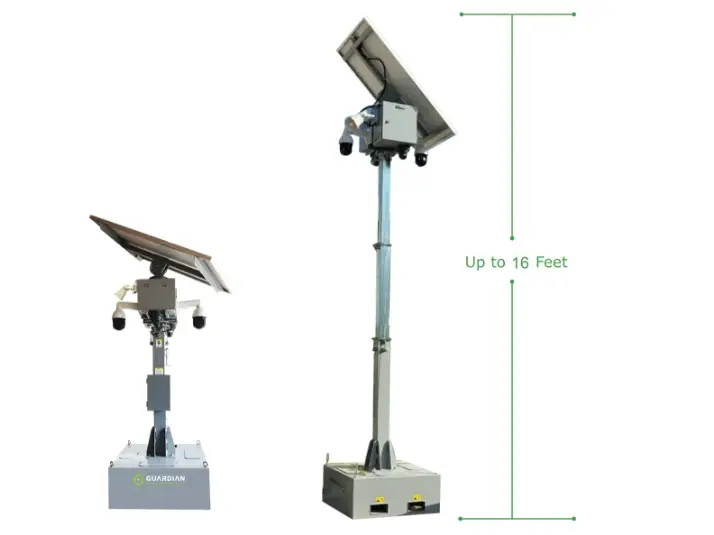
Solar-powered, rapid-deploy units for Hayward drive-up rows, RV lots and expansion phases.

Licensed guards for Hayward storage offices, auction days and staffed-lobby hours.

Marked vehicle patrol across your Hayward storage lots, perimeters and vehicle rows.

What We Watch
Every Gate, Aisle and Corridor: What Guardian Watches at a Hayward Storage Facility
Guardian’s storage facility monitoring puts trained human agents on your property’s camera feeds in real time — gates, drive aisles, hallways, elevator lobbies, the perimeter fence and the office door — watching for break-ins, tailgating and after-hours trespass instead of leaving footage for review after a tenant reports a cut lock.
AI flags activity on camera in under a second. A live agent verifies what triggered it and, if it is a real intrusion, speaks to the person through on-site speakers before a unit door comes open, then alerts and coordinates with law enforcement and sends you a documented incident report.
The economics are why most operators switch: on-site guards run $25–30 per hour, while live video monitoring runs under $3 per hour — roughly 70% less for continuous coverage of every aisle rather than one office window.

Our Operations Center
After the Gate Locks: How Our California Operations Center Covers Hayward Storage Facilities Overnight
A Hayward self-storage property runs unattended most of the hours it’s open. The rental office keeps daytime hours; the gate keeps accepting access codes well after that, and once the last car clears the keypad, nobody is on the property until the office reopens. Guardian’s California operations center covers exactly that gap for every Hayward facility it protects: trained agents on the live feeds, watching the drive aisle and the corridor while something is happening in it rather than reviewing a recording after a tenant calls. AI flags the activity in under a second; the agent confirms it on camera and speaks to the person over the site speakers before a unit door opens.
That live view answers a question Hayward’s own code already asks. Under Hayward Municipal Code § 5-7.20(m), a building that is unoccupied and left unsecured or neglected is a public nuisance the City can act on — a Notice and Order, an administrative citation, and if the condition is not corrected, an abatement whose cost becomes a lien on the property. The item is written for unoccupied buildings, but it shows how the City treats an unsecured property — and a gate left open past closing hours or a cut lock that sits unaddressed is the kind of condition Code Enforcement is set up to act on. An agent already watching the camera is what keeps that condition from ever taking hold — alerting Hayward Police with a live description and the exact location, sending Guardian’s own licensed patrol when an on-site presence is needed, and giving the operator a documented record instead of a code-enforcement notice.
Our Process
How a Guardian Trailer Deployment Works, Step by Step
a simple, proven process that keeps your business protected 24/7,
Assess
We walk the property with you — perimeter, lighting, blind spots, and the access points that matter after hours.
Install
NDAA-compliant cameras and on-site speakers, installed by Guardian’s licensed California technicians. Fast deployment for active job sites.
Verify
Our agents watch the feeds live. AI flags activity in under a second; a human confirms what it is.
Respond
Two-way audio warning on the spot, law enforcement alerted with verified detail, and a written incident report to you.
Property Types
Where Hayward Stores Its Belongings: Whipple Road Rows and Depot Road Vehicle Lots
Hayward’s self-storage supply concentrates along a handful of corridors rather than spreading evenly across the city. The Whipple Road corridor, on Hayward’s western side, carries a cluster of drive-up and indoor storage buildings — rows of roll-up doors behind a coded gate, running block after block. Depot Road, nearby, holds dedicated RV and vehicle-storage lots where the asset sits outdoors year-round. Closer to downtown and along the I-880 corridor, Hayward’s newer multi-story climate-controlled buildings put the risk indoors — elevator lobbies, hallways and loading bays instead of an open row.
Guardian covers all of it — fixed cameras and speakers for a multi-story building with defined entries and corridors, solar-powered surveillance trailers for a drive-up row, a vehicle lot or an expansion phase that needs coverage this week — across Hayward and neighboring Alameda County cities including Union City, Newark, San Leandro and Fremont.
Drive-Up Rows & Vehicle Lots
Why a Gate Code Is Not a Security Plan for a Hayward Storage Facility
A coded gate only proves a code was entered — it says nothing about who is on the other side of it once the arm goes up. On Whipple Road, where Hayward’s drive-up rows run block after block behind identical coded entries, that gap is the whole exposure: long aisles, wall-pack lighting that leaves the far end of each row dim, and an office that can’t see past its own window once the sun goes down. Depot Road is a different problem with the same fix — no rows at all, just open lot after open lot of RVs and vehicles sitting for weeks or months with nothing between them and the street but a fence. Guardian scopes each site to what it actually is: fixed cameras and speakers bolted to a Whipple Road building, a solar-powered trailer set at the end of a Depot Road row where there’s no wiring to run cameras to in the first place.
What an agent actually watches for is simpler than the geography: a vehicle that parks and idles instead of pulling up to a specific door, or a person walking the length of a row checking locks rather than heading straight to one unit. Either draws a live warning over the speaker before a bolt cutter comes out, and if the person doesn’t leave, Hayward Police get a description and a location while the encounter is still in progress — not a claim form filled out after the fact. That is also the difference between a facility that stays a normal business and one that drifts, gate by unwatched gate, toward the “unsecured, unoccupied” condition Hayward’s own nuisance code exists to correct.
Hayward Clients
Trusted by California Businesses for Two Decades
“Our liquor store had few break ins recently but since they deployed their security unit we feel very secure and have peace of mind now! They constantly dispatch warnings to suspicious trespassers!”
— Nabil Tadlaoui, Google Review
Nabil Tadlaoui Google Review
Hayward Data
Hayward Police Logged 74 Property-Fraud Offenses in Six Months — Two-Thirds During Business Hours
Hayward Police Department’s open crime data has no field that isolates a self-storage facility from any other building — the same limitation every other Guardian page for this city discloses — but it does carry three categories built around a single pattern: property that changes hands after it is stolen, taken by extortion, or handed over on a false promise. In a rolling window that covered 6 March through 2 September 2026 at the time of this query, Hayward Police logged 74 such offenses: 27 involving a vehicle or vessel obtained by theft or extortion and then purchased or received, 26 of obtaining property, labor or services by false pretenses, and 21 of receiving stolen property.
49 of the 74 — 66.2% — occurred between 9 a.m. and 9 p.m.; Thursday was the single busiest day (21 offenses, 28.4%), and one HPD patrol beat, named “B,” carried the largest share (17, 23.0%). For a storage operator, the pattern reads as a caution rather than a location: a facility with an unwatched gate and an unwatched row is exactly the kind of low-friction property a person moving stolen or fraudulently obtained goods would prefer to use.
Source: City of Hayward Open Data, Hayward Police Department Public Crime Data (ArcGIS FeatureServer). Figures are the six-month rolling window from 6 March 2026 through 2 September 2026, queried 3 September 2026, for offenses coded “Receiving Stolen Property,” “Vehicle or Vessel Obtained by Theft or Extortion; Purchase or Receipt of Same” and “Obtaining Property, Labor or Services by False Pretenses” — all confirmed coded against property. The dataset carries no premise-type field, so these are citywide counts, not filtered to a storage-facility subset. The layer is continuously updated, so a later query will return different counts.
See the citywide data: Hayward Burglary Statistics
FAQ
Questions Hayward Storage Operators Ask Guardian
Does California's Self-Service Storage Facility Act require a Hayward storage operator to provide security?
No. The Act — Business and Professions Code §§ 21700–21716 — governs the rental agreement, the owner’s lien and the lien sale: it defines a facility as space occupants “are to have access to,” gives the owner a lien on stored property, and sets the enforcement sequence: after 14 consecutive days of unpaid rent the owner may send a termination notice setting a date at least 14 days out, and only if the sum is still unpaid on that date may the owner deny access, enter the space and remove the contents. No section requires cameras, lighting, alarms or guards. Hayward’s own municipal code comes closest to touching the subject, but from a different angle: § 5-7.20(m) declares an unoccupied, unsecured building a public nuisance the City can abate at the owner’s cost — a reason to keep a facility secured, not a security standard in itself.
What kind of property crime does Hayward police log that's relevant to a storage facility operator?
Hayward Police Department’s open crime data logged 74 offenses in a recent six-month window that share one feature: property changing hands after it was stolen, taken by extortion, or obtained by false pretenses — 27 involving a vehicle or vessel obtained by theft or extortion then purchased or received, 26 of obtaining property by false pretenses, and 21 of receiving stolen property. 66.2% happened between 9 a.m. and 9 p.m. Hayward’s dataset doesn’t say where these offenses occurred — the City’s crime data carries no premise field — but the pattern is the one that makes an unmonitored storage facility attractive: nobody watching who comes and goes, or what they’re carrying.
Can Guardian cover a drive-up facility on Whipple Road and a multi-story building near downtown Hayward?
Yes — both, with different designs. Along the Whipple Road corridor, where Hayward’s drive-up and indoor storage facilities cluster, Guardian pairs fixed cameras on the buildings with a solar-powered surveillance trailer at the end of the longest row, so the gate, the aisles and the fence line are watched together. For RV and vehicle storage along Depot Road, the trailer is often the whole design — no trenching, no waiting on power. A multi-story climate-controlled building near downtown or along the I-880 corridor gets fixed cameras and speakers on elevator lobbies, hallways and the loading bay instead.
Is an unsecured storage facility already a code violation in Hayward?
It can be, under a rule most operators don’t know about. Hayward Municipal Code § 5-7.20(m) declares any unoccupied building that is unsecured or neglected a public nuisance, enforceable the same way as any other nuisance under the City’s Community Preservation ordinance: a Notice and Order giving the owner a window to correct it, an administrative citation if it isn’t, and if the City has to abate the condition itself, the cost becomes a lien on the property. It’s written for unoccupied buildings, but a gate that won’t latch or a breach that sits unaddressed for days is the kind of condition the item is set up to reach. Guardian’s live monitoring is built to catch that condition the moment it starts, not after Code Enforcement does.
Let's Connect
Put Live Eyes on Every Aisle of Your Hayward Storage Facility
Free site assessment, no obligation. Tell us what you need covered and we will scope it.
Reviewed by the Guardian Integrated Security editorial team · CA PPO #121089 · Last updated 10 September 2026